BLUETTI AC200L: the one that grows with you
Day one, it’s the familiar two-night fridge tank (2,048 Wh) at $899. The reason to pick this one is the years after: BLUETTI’s extra batteries can carry it to 8,192 Wh, the biggest room-to-grow in the class, all feeding the same quiet 2,400-watt, 120-volt inverter. Buy it once, deepen it when the outages say so.

The short version
- The BLUETTI AC200L holds 2,048 Wh, two nights of fridge, with a battery family that can grow it to 8,192 Wh, the largest 120-volt ceiling in this class.
- The inverter is 2,400 watts at 120 volts, the weight a park-it 62.4 lb, and the price $899 on August 26, 2026.
- The surge cell stays blank because BLUETTI never prints one clean number, and we'd rather leave it empty than guess.
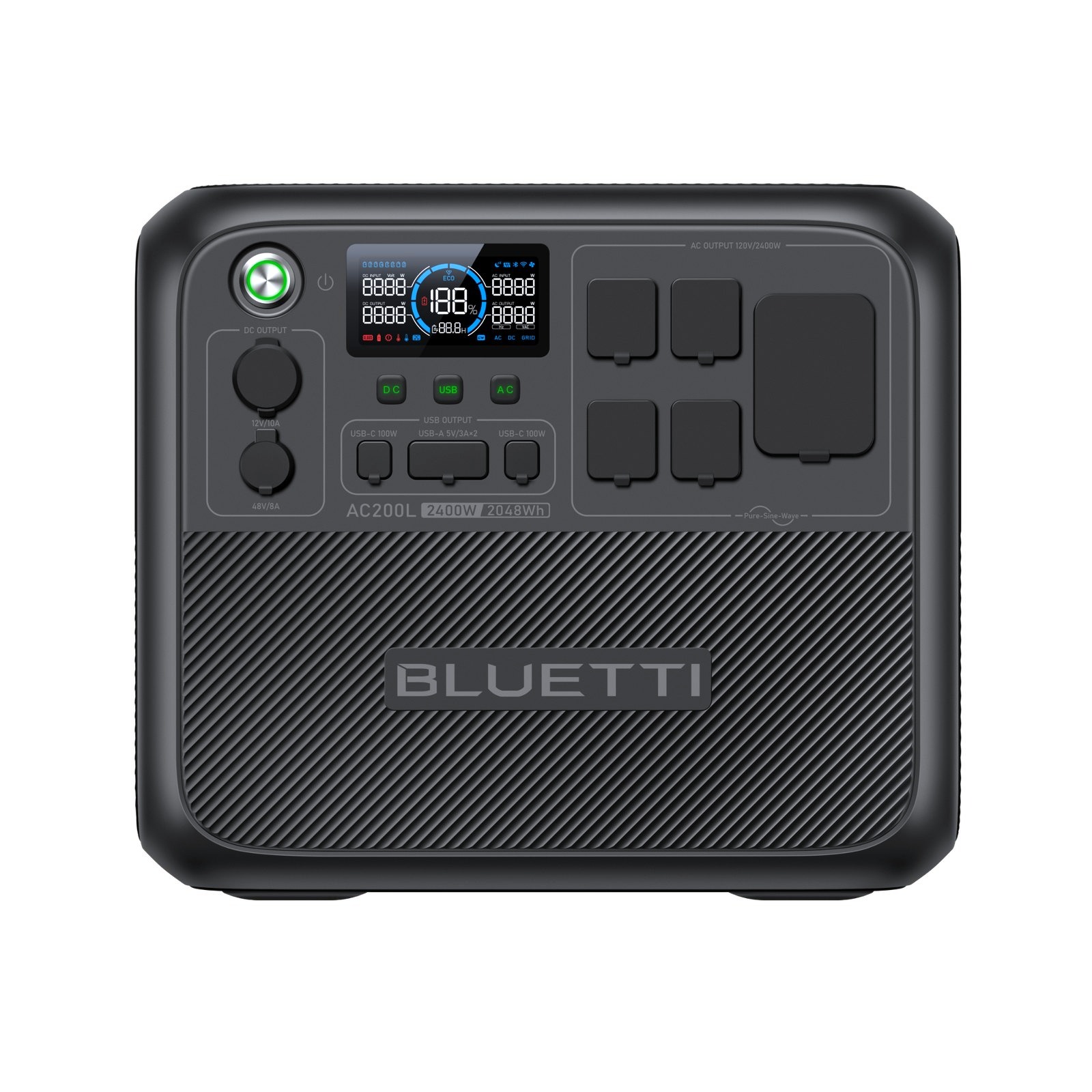
Most expandable
BLUETTI AC200L
Buy it once and add batteries later: it climbs to 8,192 Wh when your outages tell you to.
$899
Price checked Aug 26, 2026
Lovely fit if
- The job today is the fridge and the internet, and you like knowing more watt-hours can be added later without replacing anything.
- The extra battery is a real line in next year’s budget, not just a comforting screenshot of a ceiling.
- You’ll stay on BLUETTI cables, and you’ll check the solar voltage math before any panel goes in series (the matched panel makes that easy).
- 62.4 pounds parked on a kitchen or garage floor suits your plan.
Better served elsewhere if
- Anything on the must-list runs at 240 volts. Extra modules deepen this tank but never add the missing leg. That’s the F3800 or a standby generator.
- You want the roomiest inverter in the class: the Explorer 2000 Plus carries 3,000 watts to this machine’s 2,400.
- The station has to be carried, not parked: the C2000 Gen 2 is twenty pounds kinder.
- You know you’ll never buy a module. Then you’re paying for an attic you won’t use, and the best-of page will re-sort the trio for you on inverter and weight.
The numbers, translated
Copied from BLUETTI’s US product page on August 26, 2026. Where that page went vague, our cell went blank, because a guess dressed as a spec helps nobody.
- How much it holds. 2,048 Wh, the same two-nights-of-fridge planning tank as the Anker, and 5.2 Wh more than the Jackery, which is the kind of difference only a spreadsheet could love. The real runtime math lives in the buying guide.
- Steady output. 2,400 watts, comfortable for a refrigerator and the small stuff once the compressor settles, and tighter than the Jackery’s 3,000 when you deliberately stack a microwave on top. Know your evening’s shape and this number is plenty.
- Surge. Left blank. BLUETTI’s pages never settle on one figure, so we won’t settle for them. Any roundup showing a confident number here found it somewhere we wouldn’t print from. Start your own fridge on it once, on a calm day, and you’ll know more than the internet does.
- Weight. 62.4 pounds, heaviest of the three by a single pound. This is a park-it machine, so give it a permanent address.
- Voltage. 120 V, at any number of modules. Worth reading twice if there’s a well pump in your life.
- Battery type. LiFePO4, the patient chemistry that waits well and cycles happily.
- Room to grow. Up to 8,192 Wh, the largest 120-volt ceiling we can quote in this class, and the reason this machine keeps appearing in home-battery conversations. The 240-volt fork it doesn’t cross lives at the home batteries that grow.
- Price. $899 that day, with no crossed-out number beside it. BLUETTI didn’t show one, so neither do we.
What a night on this machine looks like, what hums and what fails, is at stations for home backup. The family rivalry: Jackery vs BLUETTI vs Anker SOLIX.
What 8,192 Wh actually buys you
Let’s keep the promise honest, because it’s a good promise when read correctly. Day one is still a 2 kWh machine. The ceiling is a later purchase, made module by module. Each one buys time on the same gentle inverter: more fridge cycles, more router evenings, more nights the kids’ lamps stay warm. What no module buys is a well, a dryer, or central air. If any of those words are on your list, the shopping ends here and picks back up at the F3800.
The telling detail nobody mentions: floor space is part of the product. The core is 62.4 pounds, the module weights weren’t in our dated snapshot (the live page will say), and a tower of batteries wants a wall that stays walkable in the dark. A battery you can reach with a flashlight in one hand is a plan. A battery behind the Christmas boxes is a story you’ll be telling later.
One small clarity for the search-engine confused: this machine shows up under “home battery” because of that ceiling, and it’s still a 120-volt station. On this site “home battery that speaks 240 volts” means exactly one cabinet, and it isn’t this one. The $899 buys the core and nothing else. The attic comes later, module by module, and that’s honestly the charm of it.
Refilling it, and the SP200L pairing
The wall refills it between flickers. BLUETTI’s charging wattage and minutes-to-full weren’t among our dated fields, so glance at the live page if quick recovery matters to your week.
For sunshine, the matched folder is the SP200L: 200 watts of daylight, 17.15 pounds, $399 on August 26, 2026. And, delightfully, it’s the one panel in our catalog whose open-circuit voltage BLUETTI prints plainly: 24.6 V. That’s a number you can actually do arithmetic with. Check it against the station’s solar maximum, leave margin for cold bright mornings, and remember that wiring two panels in series roughly doubles it. (Its weather-sealing rating is the one blank cell on that card, because the page never gives a clean one.)
Scale your hopes to the glass: 200 watts is a lovely trickle against 2,048 Wh and a modest one against a full 8,192 Wh tower. An overnight outage needs no panel at all. A long weekend of grid-down sun is where the folder earns its keep. The gentle rules: panel buying guide · the panels worth unfolding · the solar category.
$899 at BLUETTI, opens in a new tab
Price checked Aug 26, 2026
What we’re not claiming
8,192 Wh is a ceiling, not a box that arrives. Modules cost real money and real floor space, and stock has moods. Nobody here has run a full tower through a winter. EcoFlow isn’t featured (7-day affiliate window, poor fit for slow deliberators like you and us). Powerwalls and rooftops live on other sites.
If you buy after following a link here, we may earn a small commission. Your price doesn’t change. Disclosure · corrections · privacy.
The fit line. Three thousand steady watts is the Explorer 2000 Plus’s argument, not this machine’s. A station you genuinely carry is the C2000 Gen 2. And any 240-volt load in the house sends you to the F3800, however many modules you stack here. But if a second battery is already penciled into next year’s budget, and you like buying a thing once, the AC200L is the one that grows with the house. Class picture: best portable power stations · the category.