What a whole-house generator really costs
The number on the website is the machine. The number on the quote is the project: concrete, gas, the transfer switch, the inspector’s visit, and the oil changes for years after that. Let’s hold the whole invoice up to the light together, so no dealer gets to surprise you.
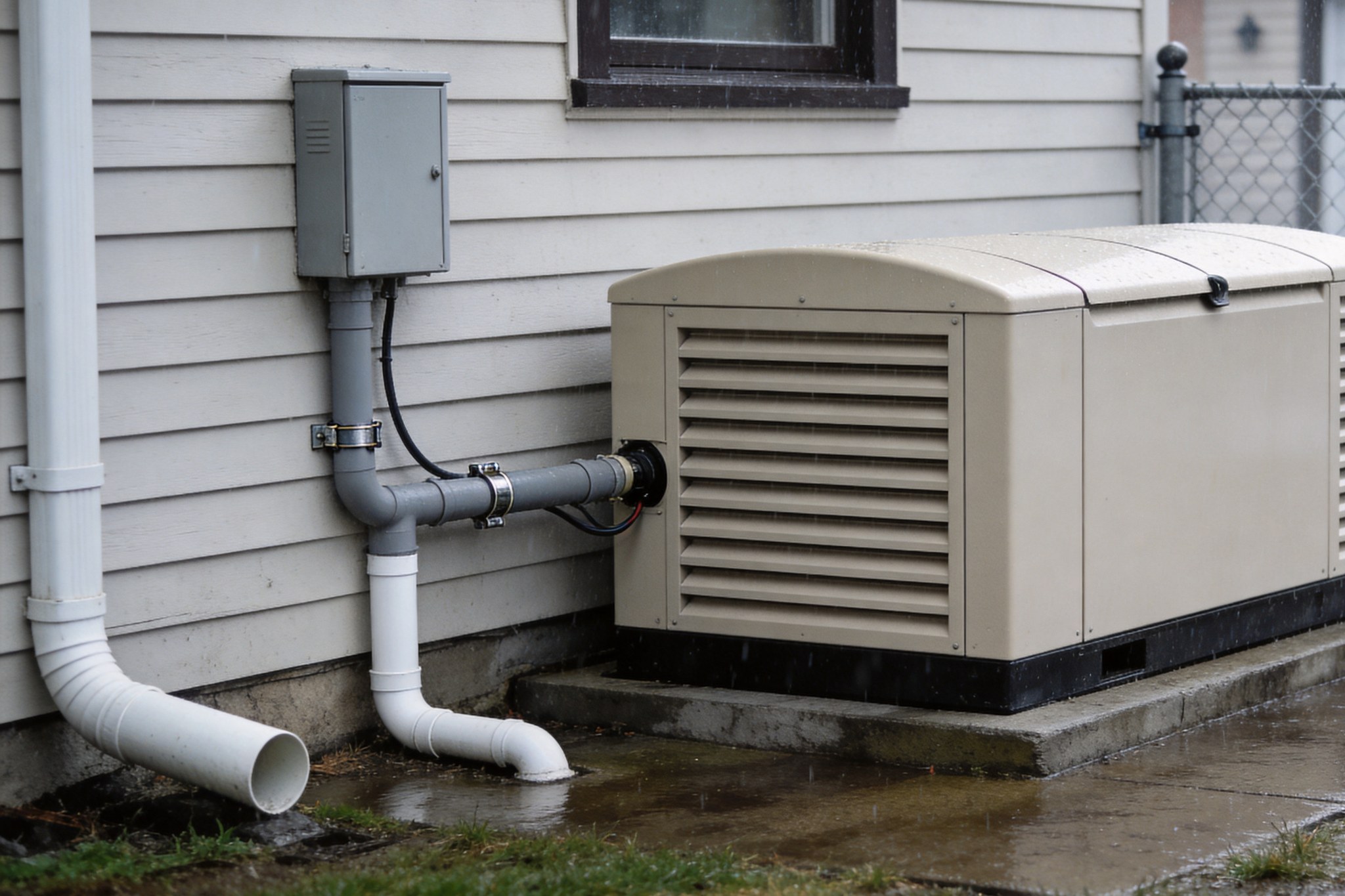

The short version
- Whole-house generator cost is three invoices wearing one name: the equipment, the install, and the years of ownership after.
- A straightforward air-cooled automatic job usually lands between $7,000 and $15,000 all-in, climbing from there with complicated gas or a liquid-cooled class.
- These bands are planning fences, not bids.
- Read them before a dealer quote reaches you, and the conversation goes a good deal better.
Here’s the trouble with generator prices: websites price the engine, dealers price the project, and the gap between them is where budgets go to be surprised. So we publish the order-of-magnitude numbers a neighbor would give you over the fence, which is enough to tell a serious bid from a teaser. We’re not a dealer, nobody here profits from your engine, and your market will bend every band below (union labor, rocky trenching, an old panel, a propane tank at the far fence line all have opinions). Treat each number as a planning fence, then get two written bids. The class decision comes first: air-cooled versus liquid-cooled · the sequence: the buying guide.
Three invoices, one purchase
“What does it cost” hides three answers. The equipment is the engine, the enclosure, and often a matching transfer-switch kit. The install is concrete, electrical, gas, and the inspection dance. And the ownership is oil, filters, a starting battery, exercise runs, and a service arrangement that outlives the warranty card. Shop the unit price alone and you’re browsing a catalog, not planning a machine.
| Line item | Ballpark | Why it moves |
|---|---|---|
| Air-cooled unit (about 10–12 kW) | $3,000–$6,000 | Brand, enclosure, Wi-Fi module, whether the transfer switch is bundled |
| Liquid-cooled unit (about 20–24 kW) | $5,000–$10,000+ | Kilowatts, sound package, longer-duty hardware |
| Install + transfer switch + concrete | $3,000–$10,000+ | Trenching, panel age, load-shedding kit, your labor market |
| Gas line / tank work | $500–$4,000+ | Meter capacity, trench length, propane tank and regulators |
| Permits / inspection | $150–$800+ | Your town, re-inspections, HOA drawings |
| Annual service | $150–$400 | DIY oil versus a dealer visit; more if the engine sat neglected |
Add it up for a straightforward air-cooled automatic install and you land at $7,000–$15,000 all-in, most of the time. That’s the number to carry around in your head. Complicated gas, a long trench, a service upgrade, or a liquid-cooled “run everything” job climbs from there, and a big house with the wrong pipe can pass $20,000. If the $7k–$15k fence ends the conversation at your kitchen table, that’s genuinely fine. It doesn’t mean you go unprotected. It means you’re shopping a different, cozier category, and we’ll walk you over there at the end of this page.
Ownership is the line everyone forgets and the machine never does. Exercise runs burn a little fuel and a little neighborly patience. Oil and filters are pocket change next to a seized engine. The starting battery that dies quietly in year four is a Saturday without backup. Dealer service in the $150–$400 band is how most of these plants actually stay alive. DIY is honorable too, if you will truly do it. An unmaintained $10,000 install isn’t “paid off.” It’s a surprise, scheduled for later.
Who this check is for
The money is well spent when
- A finished basement floods without its sump, or the well is the only water.
- Medical needs, mobility, or real winter make a two-day outage a health problem, not an inconvenience.
- Your outages are measured in days, especially heating-season days.
- The house must keep itself while you’re away. Automatic is the whole product then.
- You’ve priced hotels, lost groceries, and wet carpet honestly, and the machine still wins over a decade.
Hold the checkbook when
- You rent, or the permit and HOA answers aren’t in writing yet.
- The honest budget is station-sized. That’s a happy discovery, and a cheaper one.
- Nobody will maintain an engine, or you really wanted solar on the roof.
- The load list doesn’t exist yet. Kilowatts without a list is browsing, not planning.
This check is for the house that must behave like a house when the utility doesn’t. And if a 240-volt well is your one non-negotiable, price the split-phase battery path beside the pad before you sign anything. Different physics, different invoice, and sometimes the cheaper honest answer. Start at battery vs standby and the Anker SOLIX F3800.
A kind word about vanity plants
Some liquid-cooled money is really status money, and it’s worth saying gently. Running the dryer and both condensers through an outage that shows up once every three years. A Wi-Fi module and a color-matched enclosure bolted onto a gas meter that’s still too small. “Whole house” said out loud for the neighbors, when a load-managed 10–12 kW machine would have kept the heat, the well, and the groceries without breathing hard. The bigger class is genuinely real when the heat pump’s starting surge demands it, and the math will say so plainly. Otherwise it’s jewelry with a crankshaft. Hobbies are allowed. Just don’t file one under insurance.
It’s also vanity if it never gets its oil. An engine that sits eleven months without exercise is a sculpture with a warranty. Check your honest outage history: a four-hour flicker every couple of years, with a fridge a power station could carry? Then the $10,000 pad is a hobby, and the station is the plan.
(Rooftop solar with a wall pack is a third budget entirely, and we won’t sneak it into this category. If an installer is quoting your roof, you’re on a different site by design: about.)
Eight questions that keep a quote honest
- “Show me the load calculation.” Running and starting watts, and which loads get shed. No load calc means they’re selling a box, not a plan.
- “What’s the altitude and temperature derate at my address?” The nameplate shrinks uphill, and good dealers know by how much.
- “Which transfer switch, and who lists it?” Whole-panel, load-shedding, or a managed panel. The answer shapes half the invoice.
- “Will my existing meter and pipe feed this engine, or is the upgrade in the bid?” A starving engine sags exactly when you need it.
- “Who pulls the permit, who calls inspection, who returns if it fails?” Names, not shrugs.
- “What’s included?” Pad, trench, start-up, first oil, warranty labor radius. Itemized, in writing.
- “What does year two cost me?” Service contract versus DIY, with real numbers.
- “Where does the exhaust point, and what clearances did you measure?” Make them walk your lot, not their showroom.
Get it all in writing. A low equipment number with a vague “install TBD” is how $4,000 becomes $14,000 by Thanksgiving. Compare two bids on the same load list, never on brochure gloss. And if a quote fights the order of operations in the buying guide, trust the load list. The automatic-versus-driveway question also moves this invoice: standby vs portable.
If the fence says no, you still get backup
Suppose $7k–$15k simply isn’t this year’s number. Wonderful news: backup still exists, it just hums instead of roars. A power station carries the fridge, the network, the lamps, and most medical devices for hours, indoors, without a single fume. Expandable home batteries add stored days, and on the F3800, real 240 volts. Neither replaces a well-plus-heat-pump plant through a week of ice, and both beat an engine you couldn’t afford to install correctly.
The shops we actually link: Jackery, BLUETTI, and Anker SOLIX. Same price to you, and no invented generator link sitting beside them. Why those brands: how we review · the arrangement: disclosure.
These bands are planning numbers for 2026 conversations. Your city is promised none of them. Confirm live quotes, fuel rates, and whether the HOA will even allow the pad. Questions about any sentence: contact. We’ll cheer you on. We won’t price your trench from a desk.
Tonight’s small homework, worth more than any brochure: write the loads down, give the 240-volt ones their own line, and ask every dealer for the load calculation before anyone says a price. The list runs the meeting after that, exactly as it should.