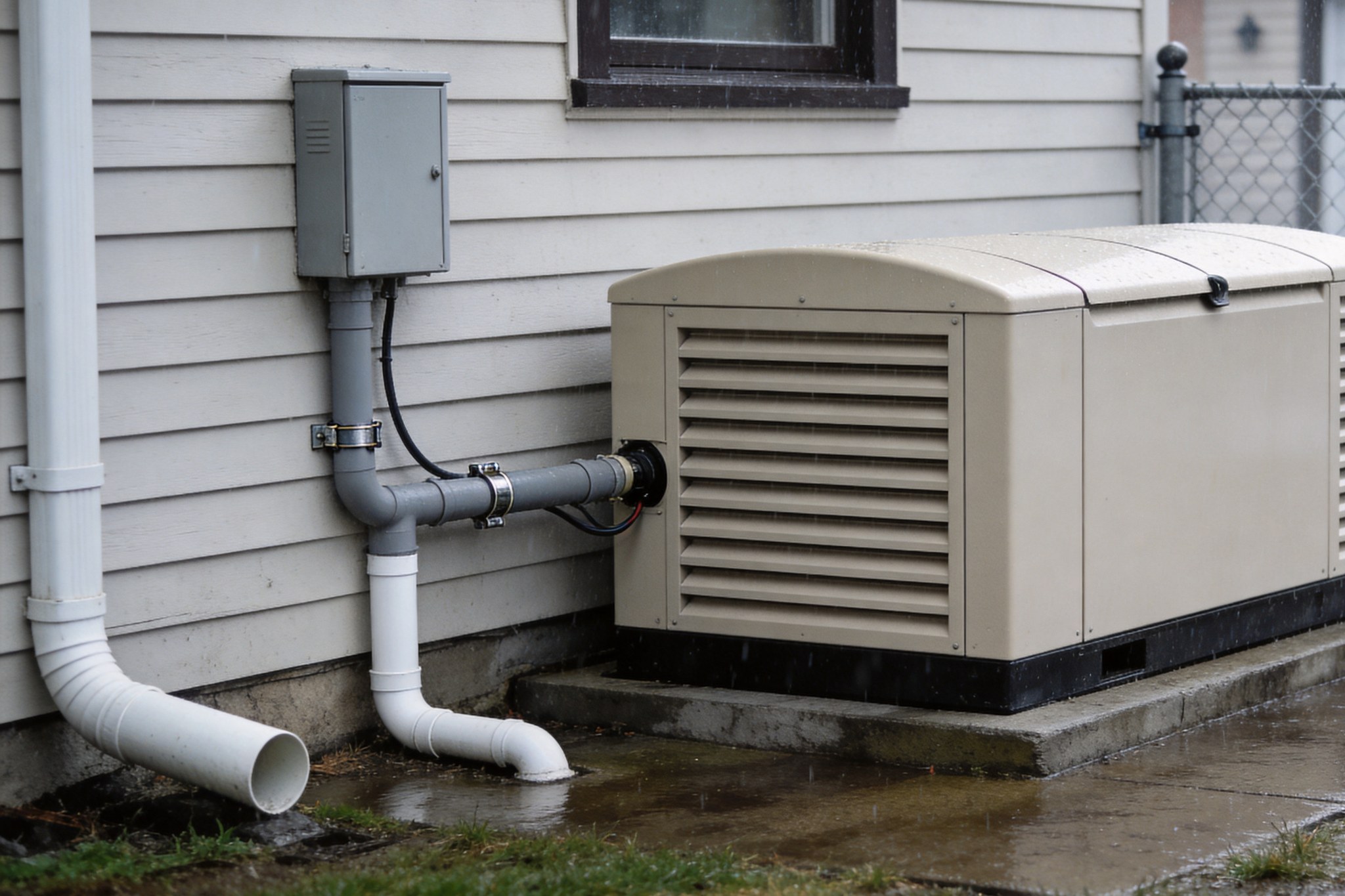
The best standby generator is a class, not a badge
Those “top ten whole-house generators” lists ranking ten nearly identical 22 kW units? That’s not how anyone who installs these things actually specs a job. The real decision is which class of machine your house needs: air-cooled, liquid-cooled, or a portable with a proper inlet. It’s a friendlier decision than the listicles make it look.
We buy nothing on your behalf and take no payment for a good word. Prices carry the day we checked them.
The short version
The best standby generator is a class, not a model: air-cooled automatic in the 9–12 kW range, liquid-cooled at 20 kW and up, or a portable plus a legal inlet.
This page sets the three classes side by side on load, fuel, and install, with no ranked trophy units and no fake buy buttons, then names the quiet figures (altitude, motor-starting amps) that decide whether "whole house" survives your actual house.
A cheerful confession first: nobody here profits from your generator. Jackery, BLUETTI, and Anker SOLIX don’t make engines, so this page has no carts to push. Just the class decision a good local dealer will eventually walk you through anyway, offered here first and for free. Get the class right and everything downstream (the quote, the gas line, the inspection) goes smoother. Get it wrong and the mistake costs four figures in either direction: a 10 kW machine that will never start the heat pump, or a liquid-cooled plant poured for a house that needed half of it.
So read the quick picks, then the table, then the caveats. The caveats are where “best” either survives your address or falls over on it. Our general method lives at how we review.
Quick picks, by the house you have
Most homes that can rest the A/C
Air-cooled standby, roughly 9–12 kW, on propane or natural gas with an automatic transfer switch. Lights, refrigeration, the well if it’s in the load math, an air handler. The classic American install, and for good reason.
Big homes, heat pumps, “run it like the grid”
Liquid-cooled, usually 20–24 kW and up. Quieter at the pad, built for longer duty, and a much bigger install. The class for people who don’t want to manage a single breaker during an ice storm, and who can fund that wish.
Rare outages, willing hands
A portable generator plus an inlet box and interlock. You are the transfer switch: cheaper hardware, real carbon-monoxide discipline, zero set-and-forget. The full trade: standby vs portable.
Fridge, CPAP, and Wi-Fi, with no pad at all
Skip this category with our blessing. A quiet power station or an expandable home battery covers that beautifully, for a fraction of the invoice.
The classes, side by side
These rows are classes, not carts. Prices are order-of-magnitude US equipment bands, and the install is its own invoice (the cost page holds that one up to the light). Your installer confirms kilowatts, fuel, and the transfer switch. That’s their stamp, happily not ours.
A class snapshot. Not a ranked model list, and not a buy button in sight.
Class
Typical size
What it actually runs
Watch for
Air-cooled standby
About 9–14 kW (most quotes cluster 9–12)
The essentials plus some HVAC, with lockouts or load-shedding doing the diplomacy
Louder, shorter design life than liquid-cooled, and still a pad, a gas line, and a permit
Liquid-cooled standby
About 20–48 kW
Close to true whole-home, big heat pumps included, if somebody did the surge math
Install can outrun the equipment, and it wants space, airflow, and a serious gas service
Portable + inlet
3–10 kW, gasoline and/or propane
The circuits you pre-planned and labeled, no more
Manual start, carbon monoxide, stale fuel, and never a standby whatever the box says
The plain-English difference: air-cooled engines shed heat with fins and a fan. Simpler, cheaper, lighter on the pad, and the reason the 9–12 kW class is the default suburban answer. Liquid-cooled engines carry a radiator loop the way a car does, built for long duty and lower sound at the property line, which is what you’re really buying when the quote wants both condensers and the well running at once. The premium arrives as concrete, gas pipe, and a delivery truck that needs a path to the backyard.
And a friendly myth to retire: square footage is not a kilowatt formula. A tight 1,800-square-foot heat-pump house can demand the liquid-cooled class, while a drafty 3,000-square-foot gas-furnace house that locks out the A/C lives happily on air-cooled. The load list does the ranking. The buying guide helps you write it before any dealer writes it for you.
Matching the class to the household
Air-cooled 9–12 kW fits when
You’ll accept a load-shedding module, or the second condenser can sit out the storm.
Automatic start matters more than running absolutely everything.
The gas meter or propane tank can genuinely feed the machine. Worth asking early.
You want the standard install: one pad, one transfer switch, one annual service.
Liquid-cooled 20 kW+ fits when
The house must behave like the utility for days, heat pumps and all.
Noise at the property line is already a sore subject on your street.
The budget covers the install and a gas service that won’t starve a big engine.
Managing breakers mid-storm is simply not going to happen, and you know it.
Portable-plus-inlet fits when
Outages are rare, and a capable person is reliably home and honestly willing.
The electrician installs the inlet and the interlock. No window cords, ever.
Fuel storage and carbon-monoxide manners are promises you’ll keep every time.
Skip the whole category when
The real job is a fridge, a CPAP, and the internet. That’s a station, and a nicer evening.
No legal spot on the lot survives the clearance diagram. That answer is cheaper now than later.
“Home battery” in your head meant a Powerwall. Different product, different site.
The engine would never get its exercise. Unmaintained standby is expensive sculpture.
The quiet figures that decide “whole house”
Altitude, motor-starting amps, exercise, oil
Nameplate kilowatts assume friendly conditions, usually sea-level air. Climb a few thousand feet and the same machine is honestly smaller, so ask for the altitude derate in writing. A 4-ton heat pump’s starting surge can stagger a generator that passed the running-watts math, because starting current is a spike, not an average. A dealer who can talk soft-starts and load-shedding without reaching for the brochure is the dealer to keep.
“Whole house” was never meant to mean unlimited. A managed panel that rests the range and both condensers is a valid, cheaper, genuinely smart design. A plant that promises everything and then trips on the well-plus-heat-pump moment is a failed spec wearing a nice enclosure. Run the exercise schedule the manual asks for, usually weekly and under some load, and budget the oil, filters, battery, and service visit like the small ongoing friendship this machine turns out to be. Eleven months of neglect turns insurance into a project.
Placement belongs in “best” too: the perfectly sized machine in a side yard that violates window clearances or the noise ordinance isn’t the best anything. It’s a red-tagged inspection. Local rules outrank every page on this site, ours included. When two quotes disagree by a whole class, the productive argument is the load list and the gas pipe, never whose badge is on the lid.
When the better buy hums instead of roars
If the honest job is refrigeration, the network, some lamps, and a medical device, you don’t have a generator problem. You have a watt-hour problem, and those are pleasant to solve. That’s the product our partners actually make: Jackery, BLUETTI, and Anker SOLIX, at the same price to you either way, with the disclosure on every page. For 240 volts without a pad, the named machine is the Anker SOLIX F3800. For hours of essentials, read stations for home backup. And for the physics referee, battery vs standby.
The flip condition for this entire page, said once: if every load on your list is 120-volt and your outages are measured in hours, the standby category isn’t your category. Finding that out today, for free, is this page doing its job. Otherwise: size the class, then call two dealers and let them argue over your load list. The category map: generator hub · questions about any sentence: contact · the money story: disclosure.