Standby or portable? Really: the machine, or you, at 2 a.m.
A standby generator sits on its pad, notices the outage, and starts itself while you sleep. A portable makes comparable watts for a fraction of the money, and assigns every remaining task to a person standing in the driveway, rain included. Once you see the question that way, your answer usually arrives on its own.
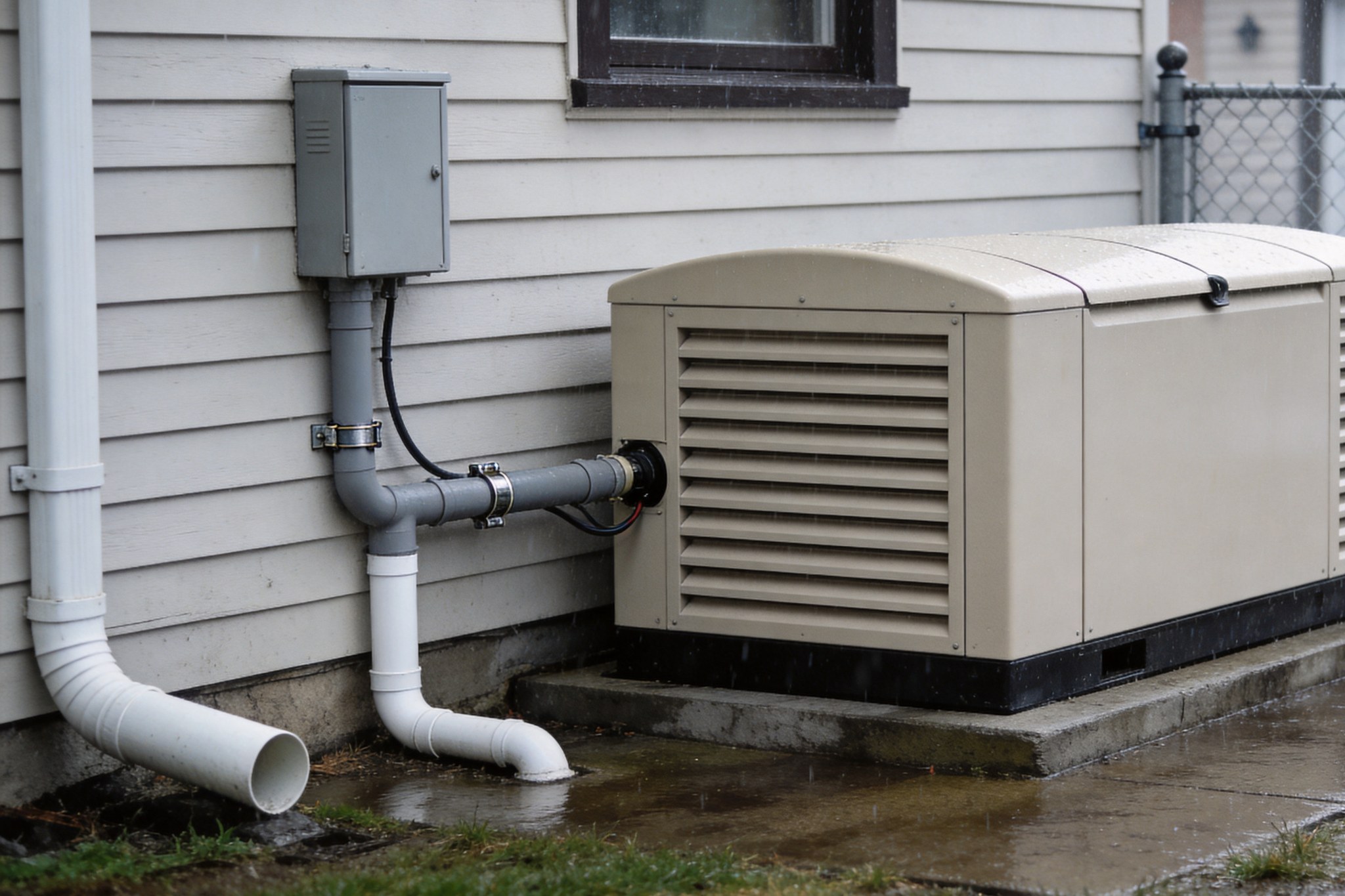

The short version
- Standby versus portable comes down to one warm question: who does the work when the grid dies?
- An automatic switch in ten to thirty seconds, or a person in the driveway.
- Cost, fuel, carbon monoxide, and the legal house hookup all follow from that answer.
- The table below keeps the two engine classes, and the quiet battery stations sold beside them, from blurring into one product.
One search phrase covers three very different machines: the automatic plant on a pad, the wheeled gasoline generator, and the quiet battery box sold as a “solar generator.” Two of them burn fuel. Only one starts without a human. This page keeps them sorted so you don’t buy a lovely indoor-safe battery for a well-pump job, or seven thousand jobsite watts for a fridge and a modem.
Full disclosure of our seat at this table: our partners (Jackery, BLUETTI, Anker SOLIX) sell batteries, not engines, so no generator on this page carries a buy button. That frees us up to be plainly useful. If your real fork is battery-versus-engine, that page referees it. If automatic is already decided, skip ahead to the standby classes and the honest cost.
What “automatic” actually buys you
An automatic standby watches the utility voltage the way a dog watches the door. When the grid sags or dies, the transfer switch isolates your house, the engine cranks, and the chosen loads come back, usually within ten to thirty seconds rather than instantly. You can be asleep. You can be two states away. What the machine still needs from you is unglamorous and non-negotiable: fuel, a healthy starting battery, and its exercise schedule. Automatic means a transfer switch plus an engine somebody maintained. There is no third ingredient.
A portable does none of that until a person does all of it: roll it out with proper clearances, start it, plug the inlet, flip the interlock so you don’t backfeed the street. If nobody in the house can or should do that work in freezing rain at 2 a.m., and there’s no shame at all in that answer, then portable is the wrong class at any wattage printed on the box. That’s the entire comparison, and everything below is footnotes to it.
Side by side, honestly
| Standby (automatic) | Portable gas generator (manual) | |
|---|---|---|
| Who starts it | The transfer switch, in 10–30 seconds, while you sleep | You, outdoors, in whatever the sky is doing |
| Fuel | Natural gas or propane, and no fuel cans involved | Gasoline or propane, and gasoline goes stale in storage |
| What comes back on | The whole panel, or a managed set of loads | Whatever the inlet and interlock (or extension cords) reach |
| Carbon monoxide | Outdoor pad with code clearances, still real and still measured | The serious one: garages, porches, and open windows have killed people |
| All-in cost | Often $7k–$15k installed for a straightforward air-cooled job | Often $800–$4k with the machine plus a legal inlet. Never “free watts” |
| Upkeep | Exercise runs, oil, a dealer visit | Same oil truths, plus storage, carburetors, and stale fuel |
Those cost rows are planning fences, not bids. Two adjustments keep them honest: a portable priced at $800 stops being $800 the day an electrician adds the inlet, the interlock, and a properly sized cord. Still cheaper, just not that cheap. And a standby at $12,000 can still beat a week of hotel, a freezer of ruined food, and a flooded basement, if those are real risks at your address. The full invoice math lives on the cost page.
Carbon monoxide, and the fuels
Combustion makes carbon monoxide, and this is the one paragraph on the site where the warm voice goes steady: portable generators hurt people when they run in garages “just for a minute,” in attached sheds, or near a window the wind favors. The maker’s clearance diagram is the minimum. Your local code may want more. A CO alarm is a smoke detector’s cousin, not a permission slip. If anyone in the house can’t reliably keep the machine outdoors and pointed away from openings, choose a different machine. Please.
Standby plants exhaust too, out on a pad, at the distances printed in the installation manual, measured from windows, property lines, and sometimes the neighbor’s bedroom. A side yard that “almost fits” is a failed inspection waiting patiently. Noise rules stack on top. Automatic doesn’t mean invisible. It means planned.
Fuel sorts the classes one more time. Natural gas is the set-and-forget choice, and it often keeps flowing under a street whose power lines came down. Often. Never always. Propane is fuel you own, tank gauge and all. Nobody can shut it off, and nobody refills it mid-ice-storm either. Gasoline belongs with portables you stand beside: easy to buy before landfall, miserable to store after. It goes stale, it varnishes carburetors, and a red can in the garage is both a fire question and roughly one evening of runtime. Dual-fuel portables soften the storage problem. They don’t make anybody automatic.
The legal hookup, in plain words
On the standby side, the real product is the automatic transfer switch, the box that moves your house onto the generator and back again. A service-entrance version can carry the whole panel if the engine and the gas line can feed it. A load-managing version keeps a smaller engine honest by shedding the range and the second condenser. Every flavor is licensed work in nearly every US town, and that’s a feature: the person pulling the permit has seen your exact house before.
On the portable side, the legal version is an inlet box on the wall plus an interlock in the panel: a humble sliding plate whose one sacred job is making it physically impossible for the utility main and the generator breaker to be on together. That plate is what keeps a line worker alive down your street. Extension cords to the fridge and a lamp are a smaller, legal-enough job, generator outdoors and cords rated. What is never on the menu: backfeeding a dryer outlet with a double-ended cord. If that sentence sounds like something you’ve seen in a video, hire the electrician before you buy the engine. The buying guide walks the whole sequence gently.
And the quiet third machine: the battery station
Portable gas generators and portable power stations share an adjective and nothing else. A station is a battery with an inverter: no exhaust, no pull cord, welcome in the kitchen. The ones we feature run LiFePO4 chemistry, hold about two nights of fridge, and refill from the wall or from folding panels in daylight. Their limit is honest: a fridge overnight is squarely their job. A well plus a heat pump for three days is not, and never will be.
If the comparison you were actually running was “quiet backup for the fridge,” the answer was a station all along. The category is right here, and the shops are Jackery, BLUETTI, and Anker SOLIX. Split-phase without a pad is the Anker SOLIX F3800’s whole reason to exist, and the night-by-night reality is at stations for home backup.
Which is yours?
Standby fits when
- Nobody should be starting machinery at 2 a.m., whether that’s age, travel, or plain good sense.
- A well, a sump, medical gear, or winter heat can’t wait for a person.
- The install budget is real. See the cost page first, kindly.
- You’ll give the engine its exercise and oil, the way it deserves.
Portable gas fits when
- Outages are rare and a capable, willing person is reliably home.
- You’ll pay for the inlet and interlock, not improvise around them.
- Carbon monoxide discipline is a promise you can keep, every single time.
- Or you get halfway down this list and realize a quiet battery station was the actual answer. That happens a lot, and it’s a happy ending.
The deciding variable is staffing, not wattage. A capable adult reliably on site with rare outages keeps the portable column standing and saves thousands. Remove that person, or add a well, a sump, or a medical load that can’t wait, and the decision flips to standby at any price. Write your own version of that sentence down. That’s your answer.
Never run a portable generator in a garage, even with the door up, even for a minute. And don’t ask a battery station to impersonate a 20 kW plant. Each machine is wonderful at exactly its own job. If this page already feels like more project than you wanted, that’s useful information: start at the station category or home batteries instead. We’re writers, not your fire marshal. Corrections at contact, the money story at disclosure.